


While I was in my third trimester, I had already gained more than the recommended amount of weight for my BMI and was anxiously scrolling through a postpartum weight-loss forum on a well-known pregnancy and parenting website where someone recommended a particular postpartum program for breastfeeding moms.
I found the program and joined their Facebook group, and quickly realized that it was all about counting calories and controlling macros, combined with rigorous HIIT workouts.
A lot of people were sharing how, despite doing everything right, “the weight won’t budge.” Others were experiencing intense cravings, or finding that calorie counting triggered an unhealthy obsession with food. (There are, of course, many reasons why you might be struggling to lose weight postpartum, which you can read about in my essay here.)
The advice to eat less postpartum really frustrates me because, as a Nutritional Therapy Practitioner, I know perfectly well that (a) not all calories are equal, and (b) reducing calorie intake can actually lower your metabolic rate over the long term.
Food is not just calories and macros. It is also nutrients, and your body needs a wide range of nutrients to function optimally.
It also strikes me as absurd that we are encouraged to “eat for two” during pregnancy - and then, after birth, we are suddenly expected to shrink back to our pre-pregnancy selves. As if growing another human inside us for nine months, and then feeding that child for months or even years, were a trivial thing a body does.
It is anything but.
In fact, pregnancy is the biggest stress test our bodies will ever endure, and it is also nutritionally expensive.
Pregnancy costs mothers around 1,000 milligrams of iron, roughly a quarter of it through blood loss at delivery. DHA is drawn down through pregnancy and lactation too: it reaches its lowest point around six months after birth and only climbs back towards the one-year mark.
And if you are breastfeeding, your skeleton gives up part of its mineral content during the first months of lactation to help make milk.
So when it comes to postpartum recovery programs, perhaps the question to ask is not necessarily:
“What do I need to do to lose the baby weight?”
It is:
“What does my body need right now to recover optimally, so that it can be healthy and strong for the years ahead?”
Because thinness is not always an indication of health.

Your postpartum body needs the right raw materials to rebuild itself
In the same way that you wouldn’t expect your newborn to grow without proper nourishment, your own body cannot repair tissue, return to optimal function, make energy, and, if you’re breastfeeding, produce milk without adequate raw materials.
There is a difference between losing weight and regaining your optimal health and vitality. You can become thinner without actually becoming stronger. You can fit back into your old clothes without having rebuilt your iron stores, muscle mass, bone strength, nutrient reserves, or metabolic capacity.
Thinness is a measure of size - but strength is a measure of capacity.
And postpartum, capacity is what I care about much more.
Can your body produce enough energy to get you through the day? Can you carry your baby without your back and shoulders constantly aching? Can you build and maintain muscle? Can you replenish what pregnancy and childbirth depleted? Can you gradually return to exercise and feel physically capable again?
Those are much more meaningful markers than the number on the scale.
So a postpartum meal plan should be built around nutrient density - not calorie restriction.
When you give your body enough protein, enough energy and the nutrients it needs to repair itself, regulate hormones, build muscle and restore metabolic function, something interesting happens: it becomes better at regulating its appetite, energy and weight on its own.
In other words, you don’t necessarily have to chase your ideal weight directly. You can focus on becoming healthy, and allow your body to find its healthiest weight along the way.
Here are some of the nutrients I think deserve particular attention.
1. Iron: replenish what pregnancy and childbirth took
During pregnancy, your need for iron increases substantially. Iron is needed to produce hemoglobin, which in turn is needed to support your increased blood volume (up by around 45%, with plasma volume alone rising by about half), the growing fetus, which needs its own iron stores, and the placenta, which must supply oxygen to the fetus.
Then delivery can cause significant blood loss, and with it, the loss of iron.
Low iron can contribute to fatigue and impaired physical and cognitive function - symptoms that are easily dismissed as simply “being a new mother.”
But between 10% and 30% of women in high-income countries are anemic after birth, and in one Norwegian cohort, a quarter were still anemic at fourteen weeks.
Hemoglobin usually recovers within about eight weeks. Iron stores take longer: they tend to stay low for several months afterwards, particularly where there was significant blood loss at delivery.
So during those critical months, while you are rebuilding your iron stores, you need to focus on eating iron-rich foods.
Food sources include:
red meat
liver
sardines
shellfish
eggs
lentils
beans
leafy greens
pumpkin seeds
Pair plant sources of iron with vitamin-C-rich foods such as peppers, citrus, berries, or tomatoes to improve absorption, and keep tea and coffee away from iron-rich meals since they can decrease iron absorption.
And if you were anemic during pregnancy or after birth, food alone may not be enough. Diet can help maintain iron stores, but rebuilding them after a significant loss can take much longer. Iron supplementation should be guided by your blood results and a healthcare professional. (Another thing I find frustrating is that the six-week postpartum check-up is often treated as the end of your postpartum recovery. In many countries, there isn’t even a full blood panel done at that point.)
2. Choline: one of the overlooked nutrients
Choline doesn’t get enough attention in mainstream nutrition - but it should.
It is a structural component of cell membranes; it is needed to produce neurotransmitters involved in brain and nervous-system function, and contributes to the production of S-adenosylmethionine (SAM), one of the body’s major methyl donors. SAM is involved in a wide range of processes, including DNA synthesis and gene regulation
This is particularly important during pregnancy, when the developing fetus undergoes extensive epigenetic programming.
Plus, choline plays a big role in how your body transports fat, so sufficient choline is also required for healthy metabolism.
Food sources of choline include eggs, chicken, beef, fish, dairy, beans and lentils, with eggs being the choline superstar here.
One large egg provides around 150 mg of choline - so two eggs provide more than half the day’s requirement on their own.
I love eggs as a postpartum food because they pack protein, choline, B vitamins, and other micronutrients into one inexpensive and easy-to-prepare food.
This is what nutrient density looks like in real life.
3. Omega-3 fats: feed your brain too
Omega-3 fatty acids, particularly EPA and DHA, are crucial for regulating inflammation and supporting brain health - in fact, the brain is exceptionally rich in fat, and DHA is found in high concentrations in brain tissue. DHA is also transferred into breast milk, making it especially important during breastfeeding, when it helps fuel your baby’s developing brain.
Sources of omega-3s:
Fatty fish such as salmon, sardines, and herring are rich sources of EPA and DHA. I would deliberately choose smaller fish such as sardines and herring because they tend to have lower mercury levels than larger fish such as salmon.
Plant-based sources, such as flaxseeds, chia seeds, and walnuts, provide alpha-linolenic acid (ALA), which the body can partially convert to DHA. The conversion to DHA is limited though, so I wouldn’t rely on plant sources alone.
A meta-analysis of eighteen trials found that omega-3 supplementation might even be beneficial as an add-on treatment for postpartum depression.
4. Calcium and vitamin D: don’t forget your bones
Pregnancy places substantial demands on your bones. Calcium remains essential during the postpartum period too - for rebuilding and maintaining bone, supporting muscle and nerve function, and, if you’re breastfeeding, producing breast milk.
During the first six months of breastfeeding, you can lose a measurable amount of bone mineral density as the body draws from your bones to obtain calcium for milk production.
One study found that bone density in the lumbar spine fell by almost 4% in breastfeeding women, while women who were not breastfeeding gained a small amount. This loss appears to be a temporary physiological adaptation to lactation, with bone density recovering after weaning.
In a randomized controlled trial of postpartum women with relatively low dietary calcium intake, although calcium could not prevent the bone loss during breastfeeding, those who received 1,000 mg of supplemental calcium experienced greater gains in lumbar-spine bone density post-weaning than those who received placebo.
The difference was statistically significant, and the benefit was also seen in both women who had breastfed and those who had not.
Good sources of calcium include:
yogurt
milk
kefir
cheese
sardines with bones
calcium-set tofu
leafy greens
tahini
Vitamin D is important too because the body needs vitamin D to absorb and use calcium effectively, and it can be difficult to get enough from food alone.
Vitamin D deficiency is also surprisingly common. In one German study, a quarter of breastfeeding women were outright deficient, while three-quarters had levels below the threshold considered adequate by most guidelines. Breastfeeding women were also four times more likely to be deficient than women who were not breastfeeding.
I live in Cyprus, one of the sunniest places in the world, and my vitamin D levels were still too low postpartum. Sunlight helps your body produce vitamin D, but living somewhere sunny doesn’t automatically mean you have adequate levels.
Recommendations vary slightly between countries. The UK recommends 10 micrograms (400 IU) of vitamin D a day during pregnancy and breastfeeding, while the European adequate intake is 15 micrograms (600 IU). Even supplementation at these doses does not provide enough vitamin D through breast milk to meet an exclusively breastfed baby’s needs, which is why breastfed infants are generally given their own vitamin D drops.
If you have a history of vitamin D deficiency, significant blood loss, a restrictive diet, or other nutritional concerns, it is worth discussing testing and supplementation with your healthcare provider rather than guessing.
5. A word on macros
As I mentioned earlier, food is more than calories and macros, which is why I don’t personally obsess over tracking them. And, in all honesty, which mom has the bandwidth to log every single thing she eats in a calorie tracker?
But I would be remiss not to talk about macros at all, because protein, carbohydrates and fats each have very different jobs to do.
Protein
Protein is the one I pay most attention to, because your body needs so much of it for repair and recovery postpartum.
Pregnancy builds a whole human, an organ from scratch (the placenta), grows your uterus to about a kilogram, and keeps your skin and abdominal wall stretched for months. Then you give birth, leaving behind a placental wound as big as a plate - and depending on how you delivered, you may also be healing from tears or a caesarean incision.
All of that tissue has to repair and remodel itself and protein provides much of the raw material. Amino acids such as proline, glycine and lysine are used to make collagen, which is central to wound healing.
There are some studies suggesting that our protein needs during pregnancy and breastfeeding may also be higher than the current recommendations.
When Canadian researchers measured how much protein breastfeeding women actually needed, they arrived at around 1.7 to 1.9 g per kg of body weight per day at 3 to 6 months postpartum. For comparison, the current RDA for breastfeeding women is only 1.3 g per kg.
I aim to include a decent amount of protein at every meal. Animal proteins are superior to plant proteins because they contain all nine essential amino acids and are generally highly digestible. You can absolutely get enough protein from plants too, but plant proteins vary in both digestibility and amino-acid composition.
Carbohydrates
Low-carb diets have become just as popular - if not even more so - than low fat diets. But we still need carbs to function optimally.
Your body breaks carbohydrates down into glucose, which your cells can use for energy or store as glycogen. If you’re breastfeeding, you’re also making lactose - and that is built from glucose too.
Once again, not all carbs are created equal.
Breakfast cereal, bagels, croissants and biscuits are one thing. They are stripped almost entirely of fiber and nutrients, are highly processed, and sometimes full of chemical additives to enhance flavor and/or increase shelf life.
But potatoes, sweet potatoes, buckwheat, quinoa, legumes, fruit and vegetables are quite another - because they also provide a good amount of fiber, vitamins, minerals and phytonutrients.
I spent a long time avoiding carbs, including perfectly nutritious ones, and all it did was make me crave them more. Sooner or later I would cave in and binge on exactly the foods I had been trying so hard to avoid.
Takeaway - don’t deprive yourself of good carbs.
Fat
Fat was vilified for decades and it is of course virtually excluded from all calorie-restricting diets. I still cringe anytime I read a meal plan or recipe that advises us to discard the most nutritious part of the egg, the egg yolk, and just eat plain egg whites.
The food industry decided to profit from this too by making and selling everything low-fat, advertising it as healthy e.g. cereals, low-fat yogurts, low-fat cheese or even deli meats.
But fat is really important.
Every cell you have is surrounded by a membrane made largely from lipids. The fats you eat influence which fatty acids become incorporated into those membranes. That in turn affects membrane fluidity and the way receptors embedded in the membrane function. The more fluid the membrane, the more efficient your cells are at (a) responding to hormonal signals (b) transporting nutrients and other substances in and out. So healthy fats => healthy cells => better metabolic and hormonal function.
So I really don’t shy away from fats.
I use extra-virgin olive oil liberally (thankfully, we have good sources here in Cyprus), and I eat avocado, eggs fried in beef tallow, and of course, oily fish, PLUS I separately take a high quality fish oil supplement.
Fat simply makes food taste good and keeps me fuller for longer.
So when I talk about macros, I am really talking about making sure all three are represented in my meals rather than trying to engineer the perfect ratio between them.
And focus on whole foods - not heavily processed foods that come in packets or freezer boxes.

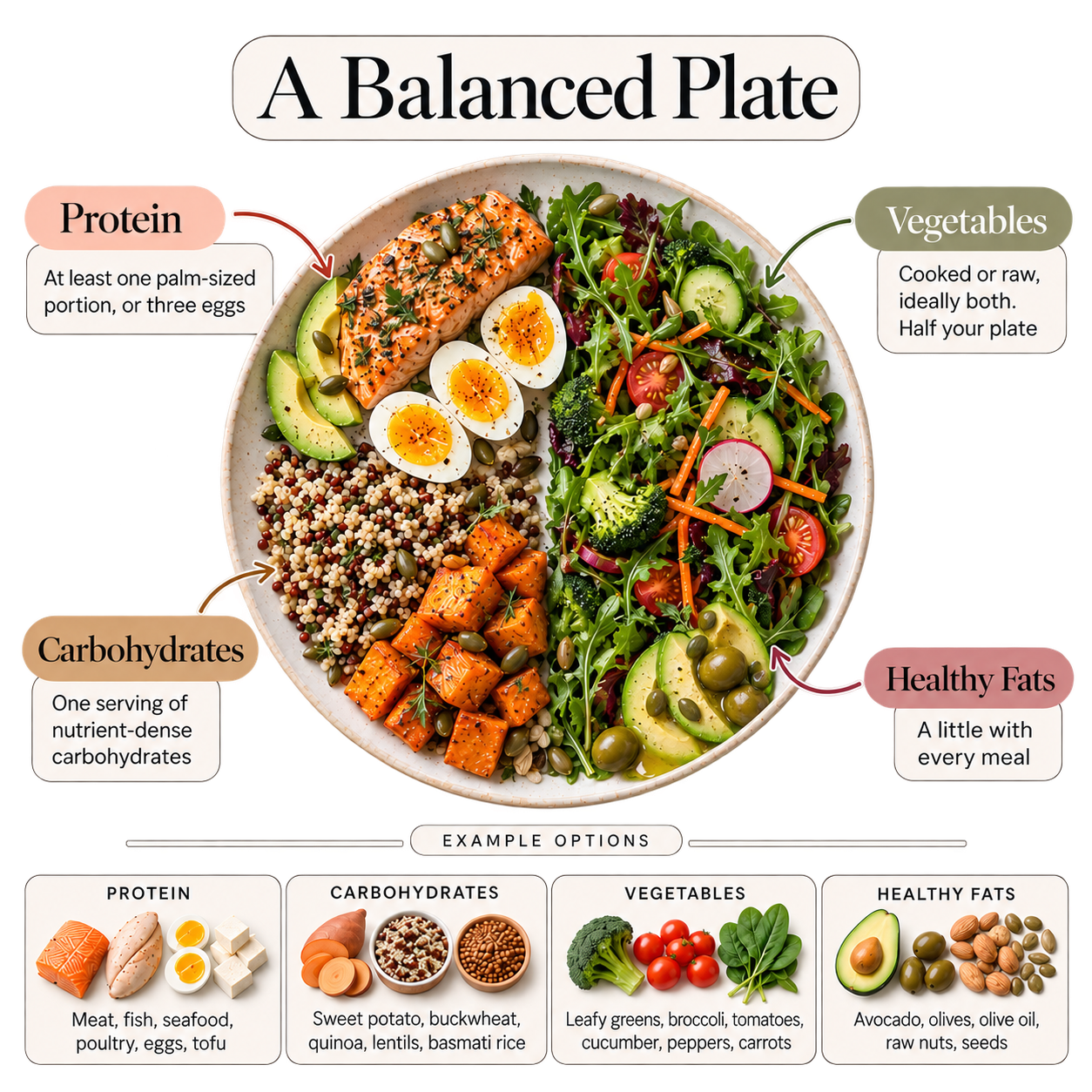
So what should a postpartum plate actually look like?
Forget complicated meal plans and calorie counting.
I would focus on choosing whole, nutrient-dense foods and building a plate around:
Protein - meat, fish, seafood, poultry, tofu, eggs (at least one palm-sized portion, or three eggs)
Vegetables - cooked or raw, or ideally both - half your plate
Healthy fats - avocado, olives, olive oil, raw nuts, and seeds
Carbohydrates - a serving of nutrient-dense carbohydrates such as sweet potato, buckwheat (traditionally used as a galactagogue), quinoa, lentils, or basmati rice
And drink plenty of water and herbal teas.
The more whole foods you eat, the less hungry you will be overall and the less prone to those intense cravings we often get, especially when breastfeeding. What has helped me personally is keeping a few meals in regular rotation to reduce decision fatigue.
Of course, there will be days when you eat a beautiful, nourishing meal, but there will also be days when you eat peanut butter toast standing at the kitchen counter while holding a crying baby… and that’s OK.
Remember: this is not a bikini competition. This is a time for healing and recovery. Be kind to yourself.

Note: I am a certified nutritional therapy practitioner, not a doctor. This essay is for educational purposes only and should not be taken as medical advice. I write about women’s health because I believe mothers deserve far better information about how to support their bodies through pregnancy, postpartum and beyond.

Thanks for sharing this! On the one hand I feel like the focus on losing weight postpartum is just insane, but at the same time I understand it can feel like someone would want to get back to a body that feels more comfortable. Yet, in the last case we should continue eating to actually! Fueling yourself in a way that supports the busy pp life is key for the energy levels and undereating should never be the strategy.
As usual, just amazing. I really love how you give examples of the foods we should be eating AND WHY!! Thank you thank you!!!