


The auspiciously timed promotion
I was in the hospital waiting for my husband to do a thoracic MRI, while my three-month-old was at home with my mother. The CFO (my direct boss) and the CEO of the company I worked at texted me 30 minutes apart, each saying that they wanted to speak to me. At that moment, anxious for my husband and sleep-deprived, my stomach twitched with excitement — it wasn’t hard to figure out that if both my boss and his boss wanted to talk to me, it probably meant that the CFO was leaving and I was being called from maternity leave to fill the role. Indeed, I was. I curtailed my — already short by some standards — leave of four months by a couple of weeks to go back to work, this time stepping in as a C-level executive. It was exhilarating. It was what I had spent nearly two decades working for, the title I had inscribed on my A-level Accounting notebook after my name as a way to manifest it. I was finally the corporate lordess I dreamed of becoming ever since I was 16 and watched Maid in Manhattan with J.Lo (about a girl with a slightly disadvantaged background rising to the top). And in all honesty, I had actually missed being in the office — being back in the game, back amongst adults, challenging my brain with tasks other than newborn care and formula dosing.
Fast forward a year later — I had caught every single virus my little one brought home. The nursery was the gift that kept on giving. The whole family spent a couple of months being sick almost back to back, going through a sinus infection, Coxsackie, and influenza. Needless to say, I had to be away from the office too, either to nurse my daughter or myself. I was pretty defeated physically and mentally. Something had to give. During the Christmas holidays, we decided that my husband would quit his job to become a stay-at-home dad, just so we could finally stop getting sick. And I could focus on work without having to be interrupted by childhood illness every other week.
Choosing between the crib and the boardroom
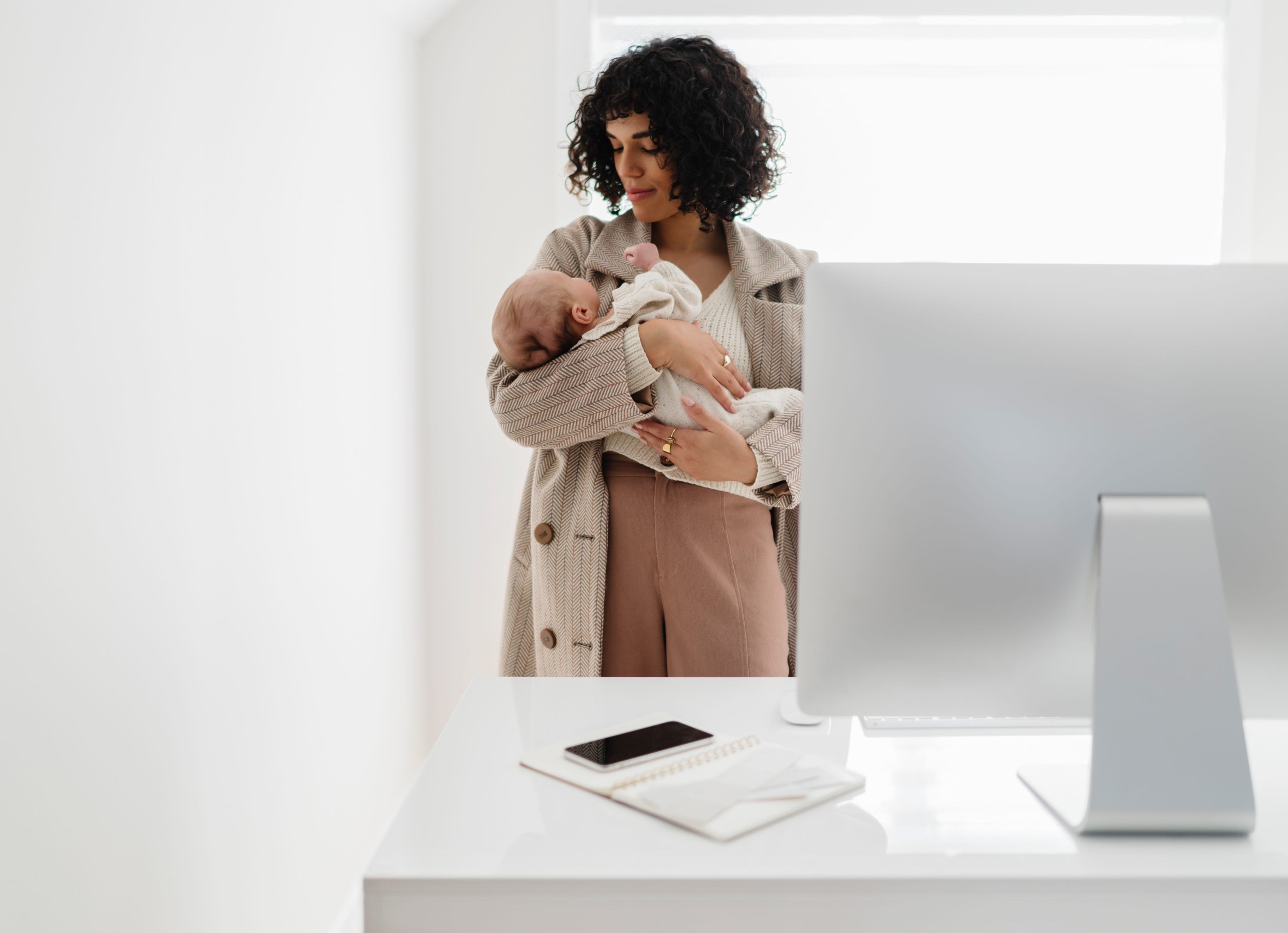
Two prominent books stand out in my mind that grapple with the conflict between ambition and womanhood. One of them propounds that a woman should do everything possible to stay in her career for as long as she can — Lean In by Sheryl Sandberg, former VP at Google and later COO of Facebook, while in The Power Pause, Neha Ruch argues that you can step back and take a deliberate career break so you can “come back stronger than ever”.
One of the central propositions in Sandberg’s book is perhaps her most cited idea of “Don’t leave before you leave”.
She notes that women begin scaling back years before they actually have children, by turning down additional responsibilities, avoiding relocation, inadvertently easing off — so that by the time maternity arrives, the job is not that demanding or even compelling enough to return to.
She writes, “Women rarely make one big decision to leave the workforce. Instead, they make lots of small decisions along the way, making accommodations and sacrifices that they believe will be required to have a family. Of all the ways women hold themselves back, perhaps the most pervasive is that they leave before they leave”.
Much of her book is about women’s self-sabotage — shying away from ambition for fear of being disliked or considered unfeminine, downshifting years before they actually become mothers, not asking for the pay rise or promotion they know they deserve. So her prescription is simple — “keep your foot on the gas pedal”, dedicate yourself entirely to your career until the time comes to start a family, so that once you become a mother, your job would have become rewarding enough for you to want to continue doing it.

But then Neha Ruch argues that a woman’s identity and self-worth are not solely defined by her career or title. Over the course of decades, a woman can pause deliberately once she is a mother to discover a new identity, interests and social circles beyond those of her job. She argues that pausing your career does not mean you have paused your life. And most interestingly, she proposes that caregiving can actually further develop your leadership skills by teaching you emotional regulation, creativity and patience. (I agree: once you have learned how to manage a raging toddler, managing an underperforming employee or negotiating with an unreasonable customer is a walk in the park.)
Ruch highlights that your skills do not disappear during your “power pause”. Of course they don’t. In fact, one of the most successful women in the company I worked at had taken a decade-long pause to raise her three kids before returning to work. And she was still brilliant at it, if not even more so.
Arianna Huffington lauded the book as a rebuke to “a culture that has told women for too long that they can’t take their foot off the gas” — an almost verbatim inversion of Sandberg’s advice. But we would be remiss not to note that there is a whole decade between the publication of these two books, and a lot of events occurred between those years that shifted that same culture which Huffington alludes to.
From Girlboss to Tradwife

Lean In landed in March 2013 into a world primed for it: post-recession recovery, tech ascendant, Marissa Mayer running Yahoo while pregnant, “having it all” the standing question. It was buoyed by Sophia Amoruso’s #Girlboss (2014), girlboss startups (Glossier, Away, The Wing, Thinx), hustle culture as feminist praxis. Female empowerment became an aesthetic and a market segment. I recall fervently liking and saving #bossbabe quotes on Instagram about female hustle and “building an empire”. But then a few things happened that shifted the mood. In 2016, Hillary Clinton was defeated by Donald Trump in America’s presidential election. In 2017, the #MeToo movement exploded. It reframed the workplace-gender problem entirely: the issue wasn’t women’s insufficient assertiveness or shying away from ambition but men’s abuse of power, which made the “negotiate more confidently” advice sound absurd in retrospect. Then the COVID pandemic broke the frame entirely. When schools and childcare closed, more than two million American women left the workforce — the “she-cession” — and the invisible care infrastructure underneath every leaning-in career became suddenly, undeniably visible. The revelation wasn’t that women lacked ambition; it was that their careers had been resting on a childcare scaffolding that could vanish overnight, and that the economy had no answer. At the same time, the tradwife aesthetic went viral on Instagram and TikTok, as an explicit counterculture to the girlboss. The girlboss edifice collapsed on its own terms: 2020 brought the toppling of the founders of The Wing, Refinery29, Man Repeller, and others amid workplace-culture reckonings, and “girlboss” curdled into an ironic slur. Many former girlbosses began publicly narrating their burnout and turning toward “soft life” and anti-hustle messaging.
So it comes as no surprise that by the time Ruch’s book was published in 2025, it became so resonant. Her whole “ambitious and feminist woman embracing motherhood” formula exists to carve a lane between girlboss and tradwife.
Do we even have a choice?
I consider myself privileged to have built the career I dreamed of having, and now, even more privileged to be in my own “power pause” phase. But the only reason I am able to pause is because I hustled hard before I had my daughter. I spent years working long hours, weekends, holidays, and in parallel studying for the gruelling exams of my accounting qualification. I absolutely identified with the girlboss/bossbabe movement, and falling asleep on the office desk was just what girlbosses did. Then I became a mother, and swiftly realised the grind was no longer sustainable. I was in the worst shape of my life, both physically and mentally. My health KPIs were in decline. So I chose to quit.
And I emphasise “chose” here because most women simply don’t have a choice. The US offers no paid maternity leave at all at the federal level. And where the entitlement looks generous in terms of duration, the pay undercuts it — as an example, both the UK and Ireland replace less than a third of average earnings, which, on the OECD’s “full-rate equivalent” measure, works out to just six weeks of fully paid leave in Ireland and twelve in the UK. To complicate matters further, in many countries childcare is scarce, and even unaffordable. Society does almost nothing for the modern mother or caregiver. It seems that raising tiny humans is a grossly underpaid and undervalued occupation.
But I can also attest to the fact that during my time in managerial roles in the corporate world, I was able to offer flexible working hours and remote work arrangements for mothers with young children in my department — simply because I was in the position to do so. And when one of my male employees asked to work from home for a while because his wife wasn’t handling the postpartum period well, I didn’t hesitate to allow it. I watched other female managers do it too: even when the company decided to announce a blanket “back to the office policy”, the “girlbosses” went against it by allowing the status quo of remote work to continue for people who very clearly did not have to be physically present to perform well.
This is where the message of Lean In is genuinely powerful for me: the more women hold real power, the more the rules can change for all of us.
And if there is one piece of advice I would give to my daughter, it’s this: Lean In, so you can Power Pause.


I haven't read Lean In, but I am about two thirds through Power Pause right now! It's definitely shifting my perspective on how I think about SAHM
Loved this piece. As a full time working mom, I feel the pull and desire for more time with my littles but it’s not a black and white decision. It helps to hear that no decision is permanent, and that each stage may require something different.