


The Train Not Taken

I remember reading Liz Gilbert’s iconic memoir Eat, Pray, Love. In it she recounts how she met a mother her age and her “rambunctious toddler” on a train to Bologna, and how, after helping them off the train, she knew with absolute certainty that she would never have children. In her own words: “I was going off to become something else in this world — I did not yet know what — but not a mother.”
It wasn’t lost on me that motherhood was being treated as a verdict. As the end of your frivolity, your spontaneity, your ability to roam the globe as a free agent: to eat, pray and love wherever and whenever (and with whomever) you please.
I was approaching my mid-thirties and I was in a loving relationship with the right person. I was financially secure; we had started building our house. I had all the right preconditions to start a family. But reading Liz’s story about her decision not to have children reinforced my deeply ingrained fears of becoming a mother myself. I did not wish to sacrifice my freedom and my career on the altar of motherhood.
On a podcast with Marie Forleo, Liz and Marie both talk about this visceral feeling, or “knowing”, that they don’t want kids — a psychosomatic aversion to the whole idea of being married with children, their bodies making them feel sick at it on some subconscious level. Then Liz states something that really struck me:
Here are the actual facts. The actual facts are that women who do not have children and are not married live longer than women who are married with children. They earn more money, they are healthier. They are less likely to die of suicide. Women without children and without marriages are less likely to commit suicide, less likely to be victims of homicide, less likely to die in car accidents. Less likely to suffer from alcoholism and drug addiction. Less likely to report themselves depressed and anxious, and more sexually satisfied than women who are married with children. It’s like there’s not a single way that you can measure success and wellbeing on any cultural or sociological scale, that unmarried and childless women do not outperform women who are married with children.
The facts
It is possible this “data” was borrowed from behavioural science professor Paul Dolan. In 2019 he published Happy Ever After: Escaping the Myth of the Perfect Life, arguing that social constructs such as career and marriage actively damage the wellbeing and happiness of the people who try to follow them. At the Hay Festival in May of the same year he made the claim that travelled around the world: the happiest and healthiest population subgroup, he said, is women who never married and never had children.
But he never had the facts exactly right. Married people report slightly higher life satisfaction on average, and parenthood splits by country: a 2016 study across 22 countries found American parents markedly less happy than American non-parents — the widest gap measured anywhere — and traced the whole of that gap to the cost of childcare and the absence of paid leave. In countries that provide both, parents come out as happy as non-parents, or happier.
Regardless of the data, the sentiment that having children threatens a woman’s independence is quite real.
On another podcast, girlboss and entrepreneur Lisa Bilyeu also spoke about her decision not to have kids as she and Tom became hugely successful and focused on building and running their multi-million-dollar businesses. Most of my friends at the time hadn’t had kids and did not seem too eager either.
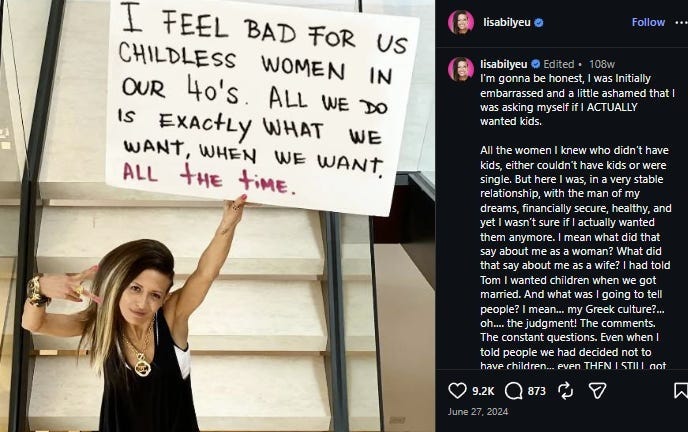
It made me wonder whether the drive to be successful made you more or less likely to want kids, and whether the girlboss culture of work-as-identity and relentless self-optimisation implicitly casts children as obstacles to leading a fulfilling and meaningful life. To being able to do “exactly what we want, when we want. All the time.”
Global fertility rates in most developed countries are plummeting — the US hit an all-time low of 1.6 in 2024, the EU 1.34, South Korea a barely believable 0.75 — and the reason is not that mothers are having fewer children; it is that more and more women are having none at all. Pew’s July 2024 report, “The Experiences of U.S. Adults Who Don’t Have Children”, found that 57% of childless under-50 adults who don’t expect kids say the major reason is that they just don’t want them; 44% cite wanting to focus on other things, such as career or interests; 38% cite the state of the world; 36% affordability. Younger women drive this: 64% of under-50 women say they don’t want children versus 50% of men.
The numbers are not surprising. To start with, having children is expensive. Raising one child to eighteen now costs $303,418 in the US, before a single university fee. Childcare alone swallows anywhere between 10% and 35% of a household’s income, against a federal affordability benchmark of 7%. The US remains the only high-income country with no federal paid parental leave. And the penalty lands on one parent (usually the mother). Henrik Kleven ran the numbers in Denmark (a country with some of the most generous parental leave in the world), and found that mothers’ earnings fall by roughly 20% after the first child and stay down for a decade, while fathers’ earnings don’t move. Claudia Goldin won a Nobel for showing much the same thing: the gender pay gap is, in large part, a child gap. The motherhood penalty is real. Against those numbers, choosing your career is just common sense.
Precarious freedom
Of course, let’s not forget that having this choice is a very recent freedom, and we should not ignore the fact that women didn’t have it for centuries, and that a lot of women globally still don’t. The full bundle of reproductive freedoms a Western girlboss now takes for granted — reliable legal contraception without a husband’s permission, legal abortion, the right to refuse sex within marriage, and independent economic personhood — did not exist simultaneously anywhere on Earth until roughly the mid-1970s to the early 1990s, and only in Western Europe and North America. Concerningly, the right to abortion is already moving backwards: the US revoked a 49-year constitutional abortion right in 2022 (Dobbs), Poland imposed a near-total ban in 2020, and per the Center for Reproductive Rights, 801 million women of reproductive age (40%) live under restrictive laws, against 1.2 billion (60%) where abortion is broadly legal. So the girlboss exercises a freedom less than one human lifetime old, and in some instances already being revoked.
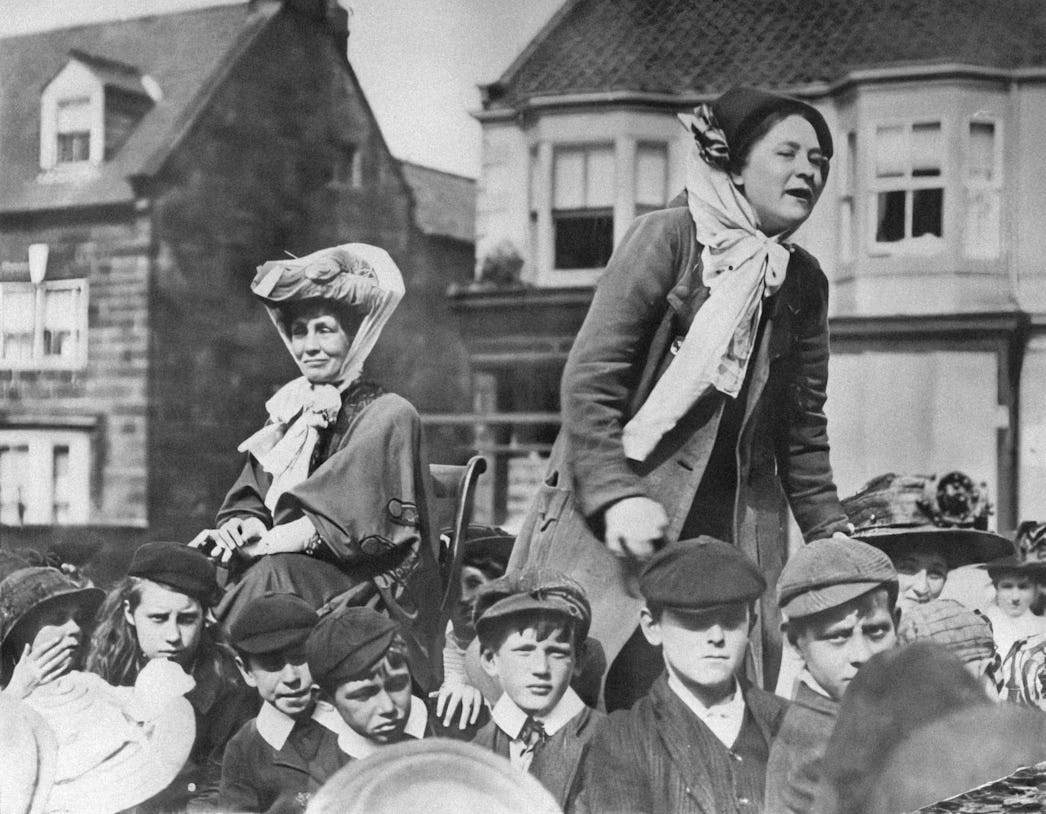
As a feminist, I firmly believe that women should have freedom over their reproductive rights, and the choice to do anything they please, and eat, pray, love and travel around the world. We are still a long way from true global gender equality, and the overturning of Roe in one of the most liberal nations in the world has been deeply disturbing, to say the least. If I had to choose between living in a world with declining fertility rates but rising gender equality and one where women had multiple children without the right to birth control or abortion or even to employment, I would choose the former any day of the week.
A different destination
But how about a world where women could actually have it all? It would not even need inventing. In Sweden, parents share 480 days of paid leave, and three of those months are reserved for the father — use them or lose them, so fathers use them. In Germany, a nursery place from the age of one is a legal right; in France, the école maternelle takes children from three, free of charge; in Quebec, a full day of childcare costs about as much as two coffees. Every piece already exists; the assembled whole exists nowhere. Now add the support no parliament can legislate — a partner who carries half the nights and half of the mental load (mine quit his job to carry his half), and an employer who treats the woman returning from leave as the professional she was when she left. Run Kleven’s numbers in that world, and the motherhood penalty disappears.
Then perhaps women would not fear losing their identity, their careers and their sanity to motherhood.
These days I am the one boarding the train with a rambunctious toddler of my own, glad of any stranger’s spare pair of hands. And parenthood is hard; I will attest to that in any court. But if I, a former girlboss myself, don’t prove to the daughter watching me that women can indeed have it all (or that at least trying is worth it), what chance do women with less privilege than me have?
Being child free can be empowering indeed. But it can also harden society’s already skewed expectations that women should be either a girlboss or a tradwife.
And that’s not what I would want my daughter to grow up believing.
I believe woman can have it all. But just probably not at the same time. If you could, you are very lucky and blessed. Just my two cents
I was comparing myself yesterday with a man who only is 3 years older than me but much more advanced in his career. And I wonder: if I hadn’t lost the time of the two maternity leaves, would I be at the same level?
It’s hard and frustrating to be a mum who coexists in an ambitious women body.