




I had my first burnout in my mid-twenties. At the time I was Head of Accounting at a fintech startup which was in the midst of filing for an IPO on the NYSE.
In parallel I was studying for my accounting qualification (the UK equivalent of the CPA) which meant that any “free” time I had outside work was mostly spent studying. I frequently left the office at around 10 pm, and also had to work weekends and public holidays, because the founder had instilled in the company the hustle culture of his own investment banking background.
For a couple of years, I only took days off to revise for my exams, and even then I was often called into the office because of some emergency or other.
It was exhilarating until it became exhausting. Tasks that used to take me 15 minutes started taking hours to complete. I would stare blankly at my monitor, willing my brain to work to no avail. The human brain, unlike a corporate budget, cannot be stretched indefinitely.
Eventually, I left and I took a six-month sabbatical to sit my final exam and recover. But fast forward a year, I was back at the same pace of work, this time at a bigger, NASDAQ-listed company. I took on extra responsibility, an exciting new project which meant frequent business travel, and continued climbing the corporate ladder for years. I cared deeply about what I did, and wanted to constantly improve every process or team that I touched. I wore my exhaustion as a badge of honour. Because that’s what girlbosses did.
For nearly two decades, I had organised my life around my professional responsibilities. If I had a demanding project, I could stay late. If I needed to catch up, I could work over the weekend. I could devote an entire evening to studying or working and leave the laundry until the next day (or… never because I could simply drop everything off at a laundry service).
When you’re young and you’re only responsible for yourself, it’s fairly easy to sacrifice your personal life in the name of ambition. There will always be time to rest later, once you have reached the next milestone.
And then I became a mother.
I was promoted to CFO just three and a half months after my daughter was born, which meant that the most demanding period of my professional life coincided with what was probably the most physically and emotionally demanding period of my personal life.
I had it all. A newborn who hardly ever slept through the night, a body that was still recalibrating after a gestational diabetes pregnancy, and a job that came with enormous responsibilities.
I had the title I had dreamed of ever since I took my first O-level accounting class at 16. But, at the same time, I could no longer organise my entire existence around work.

Balancing the Ledger
I think that one of the most difficult adjustments for ambitious women after becoming mothers is accepting that our capacity is no longer determined by us alone.
Before children, we could work as many hours as we wanted, take on an additional project, spend the weekend catching up or go on a weeks-long business trip at the drop of a hat.
But motherhood introduces an entirely different set of demands and logistical obstacles.
Your toddler gets hand, foot and mouth disease and you need to spend a week isolated then another week being sick yourself. A nursery closes on public holidays and during the summer break but your work doesn’t. And just when you think you’ve finally managed to carve out an uninterrupted hour to work during nap time, your toddler decides to nap at 3x speed and wake up earlier than you expected.
For ambitious women whose self-worth has been tied to their achievements for years, and who are used to pushing forward with the pedal to the metal, slowing down can feel painfully like falling behind. And a period of reduced – or disrupted – output can often feel like a personal failure.
There’s a particular kind of frustration that comes from having the same grand ambitions as you had before having kids (if not grander), but significantly less time and energy with which to pursue them.
You still have brilliant ideas. You still want to build things, lead projects, learn new skills, earn money, and feel intellectually stimulated, recognised, rewarded.
But you also want to be present for your children – and perhaps even find some time for yourself so you can exercise, take an everything-shower, go on a date with your partner… or just spend an afternoon reading a book (or an interesting article here on Substack!)
And suddenly, the maths just doesn’t add up.
There are only so many hours in a day, and no amount of optimisation or maxxing can manufacture more of them (unless you have full-time staff and a night nurse). What I find exasperating is how little room there seems to be in the conversation for this reality.
On one side, we have the expectation that we should continue performing at the same level as we did before having children. Pretend that our children don’t exist, even.
On the other, there’s the suggestion that motherhood should somehow be enough to make us feel fulfilled, and that we’re not good enough as mothers if we allow our kids to be raised by strangers while we continue to focus on our careers.
Neither feels particularly convincing to me.
Why should becoming a mother mean that I no longer want to achieve things outside motherhood?
And equally, why should wanting to achieve things mean that I’m expected to operate at the same pace I did before having a child?
Surely there must be some space between the hustle culture of the girlboss and the self-denial of the tradwife?
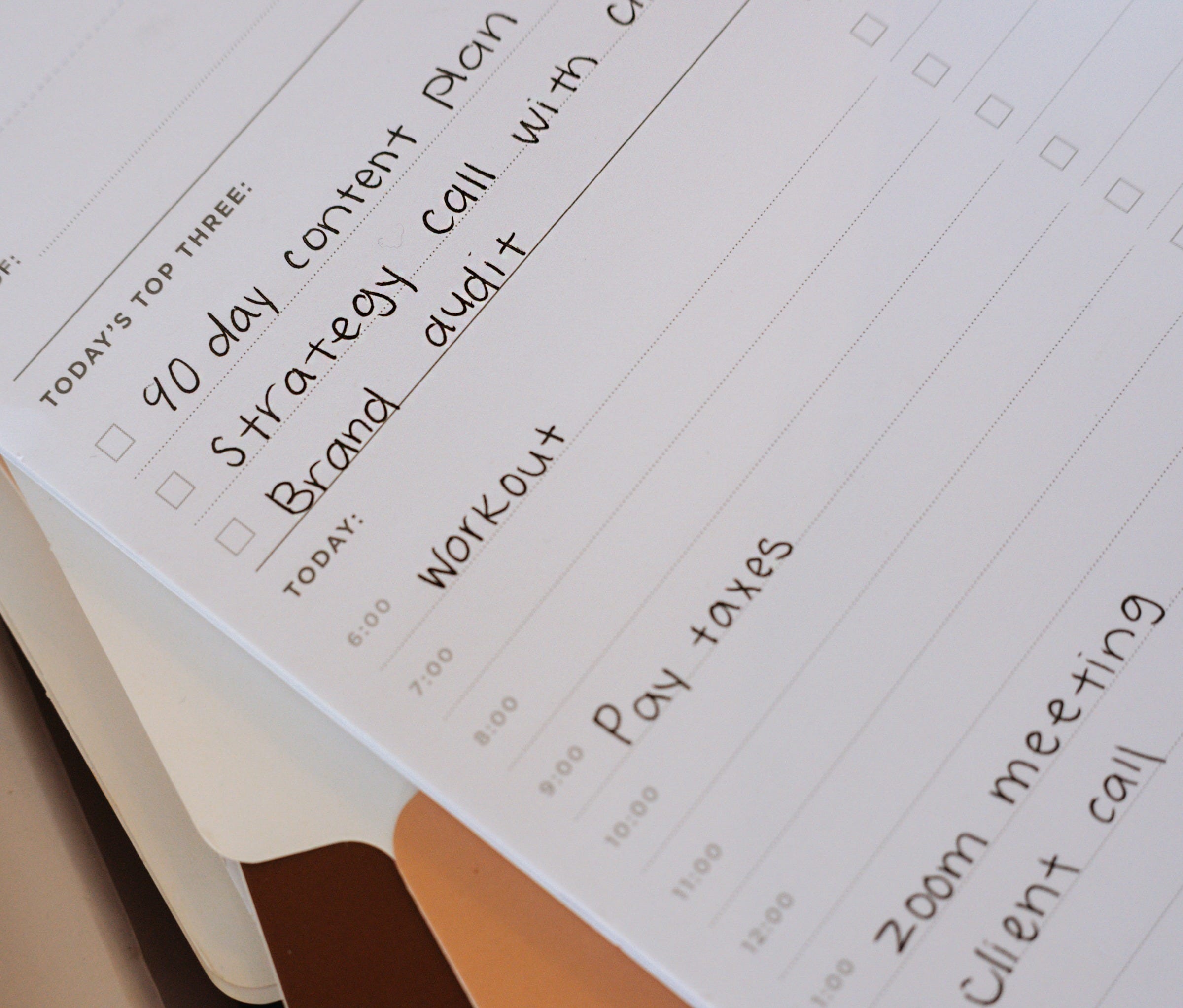
Switching Gears
The more I think about it, the more I wonder to what extent we’ve started to measure success by the pace at which we pursue it.
Somewhere along the way, we began to admire people who were always busy, always available, always launching something new, always moving towards the next milestone.
We started glorifying busyness.
Six months ago, I left my corporate career to build my own business. I wanted greater autonomy over my time, more flexibility around family life and the opportunity to create something that was mine. I wanted to put all my pent-up creativity and my obsessive need to optimise processes into something that would also use my organisational, finance and technical skills in running a business.
But I’m still trying to cure myself of the indoctrination of the girlboss. On most days, she’s still there inside me, telling me that I’m not hustling hard enough, and flagellating me because I haven’t put in a set number of hours. Instead of acknowledging all of the milestones I have reached, she’s still obsessed with the quantity of output and has even downloaded a time-tracking app onto my phone so I can log every minute of my time in an effort to make me more accountable.
And then I have to remind myself that I left my corporate career precisely because I wanted to build something sustainable, something that respects the season of life I am in now, instead of recreating the exact same working conditions of the previous two decades.
Because what would be the point of becoming my own boss if I ended up being the most unreasonable boss I’d ever worked for? And if my own business ended up burning me out, what would be left for me to do?


A Sprint or a Marathon?
Having already been through one burnout, and having become a mother, I’m now beginning to redefine what sustainable ambition means.
It doesn’t necessarily mean lowering our expectations or targets, but it does mean becoming more realistic about just how long it will take to achieve them. And it shouldn’t be about trying to squeeze more into every available hour, but about learning to keep a laser-sharp focus on the couple of priorities that truly move the needle.
Because when you’re young and child-free, you can easily work yourself into the ground.
But it becomes increasingly difficult to maintain that intensity for years while raising children, looking after your health, sustaining relationships and dealing with everything else that life inevitably throws at you.
I believe we need to accept that some seasons of life will allow us to move faster than others, but in the grand scheme of things, we must recognise that our careers and businesses evolve over the decades, and that consistency over many years may actually take us further than the occasional bursts of superhuman hustle, followed by exhaustion and constant pivots.
And, most importantly, we must understand that rest isn’t a reward we earn after completing everything on our to-do lists. Because our to-do lists are endless, and there’s always something we can do better, something to optimise, something to perfect.
I don’t want to romanticise slowing down, either.
Not all of us have a choice – there are mothers who would like to work fewer hours or stay at home, but cannot afford to. Others might be running businesses that have customers, employees, investor targets and deadlines that don’t simply disappear because they’ve decided to decelerate.
And there are women who do enjoy working intensely and find they have the stamina for it – for example, my OBGYN was pregnant with her fifth while I was pregnant with my first, and was back at work only a week after her scheduled induction, continuing to manage high-risk pregnancies and deliver babies nearly around the clock.
I don’t think there is one correct way to be an ambitious mother (or to be a mother, full stop).
Yet I wonder why we’ve become so used to treating exhaustion and busyness as a sign that our career is on the right track.
I still have big ambitions. In fact, perhaps for the first time since I was 19, I have begun to dream big again. But I also want to be there for the ordinary afternoons with my daughter, the school pick-up, the bedtime stories and the weekend adventures and road trips we like to take as a family.
And I’m no longer interested in treating every season of my life as though it should be my most productive one – because life is not linear.
For most of my adult life, I believed that ambition meant pushing myself to see how far I could go. Motherhood hasn’t taken that ambition away.
But it has made me ask this question: how far could I go if I stopped insisting on getting there quite so fast?


This is such a beautiful writing on such a complex and nuanced topic! I resonated with so much of what you wrote here - I, too, was a girl boss who glorified busyness and let work seep into all the corners of my life. Becoming a mother reset that, but in ways I wasn’t expecting. My work helped recenter me in my postpartum haze, but I also had to build a dramatically different framework around it to embrace the mother and wife I wanted to be 🤍 adjusting expectations has been such a huge part for me, like you said, and so has a focus on recovery time - and how much I get back from that. Thank you for sharing 🫶🏻
Wow, this is so relatable! I hope you find the balance and congratulations on all your achievements!