


I first heard about sleep training way before I became a mother.
As usual, the source was my Instagram feed — the profile of a functional medicine doctor I had been following for years. Coincidentally, she was also a girlboss with her own telehealth company. In her post she talked about the hard decision she had taken to sleep train, because she was way too tired trying to run a business in the middle of Covid while getting up at 3am to feed the baby.
Now, I didn’t have a baby yet, but I made a mental note that one day I would definitely do the same. I had heard stories of parents co-sleeping with their kids and thought they were too soft and weak. Did not know how to discipline their children. (Isn’t it funny how, before we have kids, we are so certain we will never be that kind of parent, doing that sort of thing?)
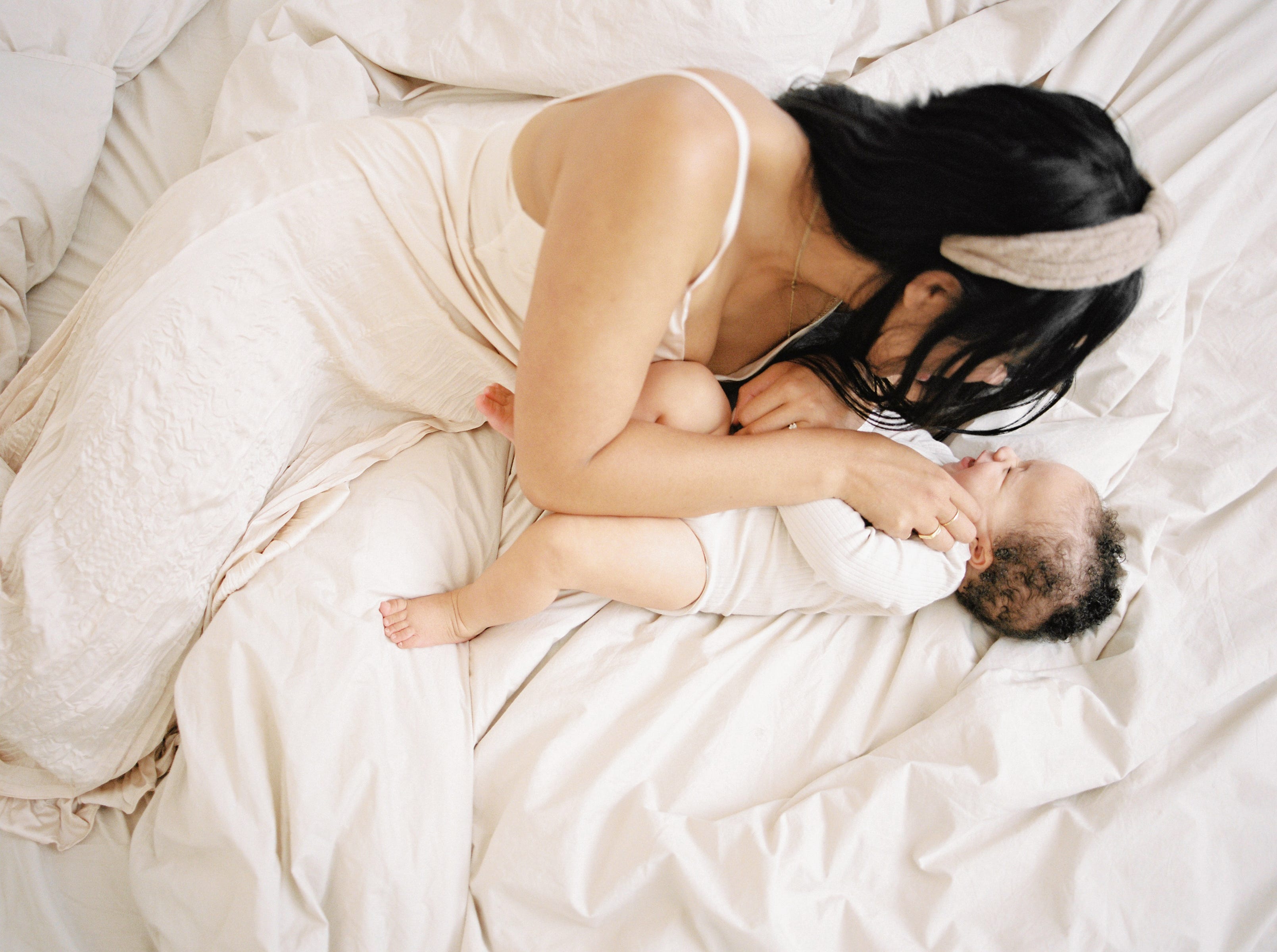
When I met my baby in the real world, I failed at sleep training miserably. Eventually we ended up co-sleeping — simply because that was the only way for me to get any sleep at all.
A catechism for mothers
The notion of sleep training isn’t new; in fact, it is more than a century old.
In 1894 a New York paediatrician named Luther Emmett Holt published The Care and Feeding of Children, subtitled A Catechism for the Use of Mothers and Children’s Nurses. The choice of the word “catechism” probably hints at what he thought mothers were for (ahm, indoctrinating?).
His book sets out the method that became known as “crying it out”: on the first night you let the baby cry in the cot, for one to two hours. On the second night the struggle is usually much shorter, 10 to 15 minutes. By the third night, the baby should have learned to self-soothe.
He explicitly banned having the baby in the mother’s bed, and ruled that by three to five months any baby could go unfed from 10pm until 6am. He also warned that picking a baby up while it cried would teach it that crying gave it control over its parents.
34 years later the behaviourist John B. Watson went even further, promoting extreme emotional detachment as the way to raise self-sufficient, independent humans. In his 1928 book, Psychological Care of Infant and Child, he prescribed no hugs and no kisses, just one kiss on the forehead at bedtime, and a formal handshake in the morning.
Perhaps it comes as no surprise that his own children went on to suffer serious mental and psychosomatic illness, and to attempt suicide.
Also, both of these “experts” were male. Neither had been a mother. They prescribed rigid, machine-like routines with one goal in mind: a “regulated” infant who does not disrupt the domestic order. In the wake of the Industrial Revolution a household was supposed to run like clockwork, just like the factory, so the mother was told to ignore her crying baby for hours and get on with the house, and to be rested and present for her husband in the evening. She was entirely dependent on him financially, which made keeping him happy and well rested a matter of survival rather than devotion. Keeping housewife and infant compliant was critical to the industrialist.
Fast forward to today, and one of the biggest companies in the world, Meta, subsidises sleep-training coaching for employees who are new parents.
The baby is fine
For most of human history and in most of the world, a baby sleeps against its mother and wakes to feed. Japanese has an image for it — kawa no ji, sleeping in the shape of the character 川, river: the parents as banks and the child as the water between them.
Dutch babies at six months sleep about two hours more per day than American ones, which is not biology — babies are identical everywhere — so it must be culture. A third of babies have still not slept through by their first birthday, plenty who have start waking again, and the laboratories that study co-sleeping pairs find mother and baby synchronising their sleep cycles, the frequent arousals possibly being part of what protects against SIDS. The night-waking baby, in other words, is doing what babies have done for two hundred thousand years. The anomaly was born in the Anglo-American nursery, with the rise of the industrial age.
The real sleep problem
Of course, we do face a real sleep problem, but guess what: it isn’t the baby’s.
Working mothers get up in the night far more often than fathers do, and they stay up longer — 44 minutes vs. men’s 30.
A French sleep clinic reviewed its case files in 2025 and found mothers doing the night care in 94% of families, fathers in 36%, even when both parents worked full-time and even after the baby was weaned. My favourite study of the lot comes from Aarhus, where researchers established that men and women wake to sound almost identically (women are about 14% more sensitive, and only at whisper volume), yet mothers still handle 76% of the wake-ups. So the dad might indeed hear the baby, but the mum is the one more likely to get up. He just goes back to sleep.
The exhaustion is real, and so is the postpartum depression that so often travels with it. A Norwegian population study found that poor sleep seven weeks after the birth predicted depression on its own, independently of everything else the researchers measured, and among mothers in their first three months, the ones sleeping badly were over three times as likely to have depressive symptoms.
What is invented is the idea that the baby must be trained not to behave like a baby.
Two plaintiffs, one defendant
The argument you actually hear is grander than any of this. One side reads sleep training as patriarchy by other means. From Holt onward, the canon of infant sleep is men instructing women to override their own responses, and the infant’s tiny body is immobilised and mechanised to run on industrial time.
Then, in the early 1990s, the pendulum swung the other way. A Californian paediatrician called William Sears and his wife Martha, a nurse, published The Baby Book and gave the counter-movement its name: attachment parenting. Everything the industrialists had forbidden was now prescribed: skin-to-skin contact immediately after birth, feeding on demand, carrying the baby in a sling for most of the waking day, and the family bed.
Sears set out his principles as the Baby B’s, one of which was “beware of baby trainers”. TIME would later call him “the man who remade motherhood”.
The confidence ran some way ahead of the evidence — Sears has said he concluded that babywearing was essential after talking to two women from Zambia at a parenting conference.
A mother following him fed the baby whenever it cried, carried it in a sling while she got on with everything else, and co-slept, naturally — which kept her within reach of the cot from morning to night. Holt had told her to put the baby down and attend to the housework. Sears told her not to put it down at all, and to be available all the time.

In 2010 the French philosopher Élisabeth Badinter turned on this second regime. In Le Conflit — published in English as The Conflict: How Modern Motherhood Undermines the Status of Women — she argues that on-demand breastfeeding, cloth nappies, co-sleeping and the rest of the ecological package amount to a regression dressed up as liberation, and she saves her sharpest pages for La Leche League. Under Sears, on her reading, a mother is still subservient to a paediatrician’s dogma — albeit a warmer one.
Badinter might have been right to a certain extent, but perhaps her motives were not entirely based on concern for modern women. She happens to be the heiress and largest individual shareholder of Publicis, the advertising group whose clients have included Nestlé — the formula company with the longest record of breaching the WHO code on marketing breastmilk substitutes — and she has said herself that the book began with France’s 1998 decision to ban formula advertising from maternity wards. So the warning about one industry’s interest in your baby reached us, in part, from a woman with a stake in another.
But it seems that whichever choice a mother picks, she ends up in the same chair — the defendant’s.
Meanwhile the conditions that make the choice agonising sit untouched.
The United States mandates not one day of paid leave for new parents. Other countries (the UK and Ireland, for example) might offer longer leave, but at a fraction of the mother’s salary, which makes it economically unviable.
A lot of women would love to be SAHMs but simply can’t afford to, and have to return to work. When they do, the nursery bill gets set against her salary rather than the household’s, so she is the one who has to justify going out to work at all — and the employer who takes her back wants the same output she managed before the baby, from a woman who has barely slept and is still breastfeeding.
So the expectations on women have risen exponentially over the past century: the early industrialists were concerned with the mother as the manager of the household plant; modern industrialists need her to continue managing it while she is employed in the machine herself. Attachment parenting expects her to run a house and a job on the same broken sleep, while the modern “sleep-training” industry sells her books and courses that will teach the baby to stop interrupting.
That is where we are, a hundred and thirty years after Holt: mothers up at 3am, wondering if they should sleep train or co-sleep, defending the choice to strangers on the internet, while no one offers the two fixes that would actually make a real difference: longer parental leave (for both parents!), and a father doing his share of the work.
The failure has been structural since 1894, but we still keep indoctrinating the mother.
Great article. I had so many of the same preconceived ideas about the kind of parent I would be. In the end, I found myself babywearing, co-sleeping, and trusting that my instincts as a mother were more valuable than the advice of someone who had never lived the experience of motherhood.
The system has failed us in so many ways by making mothers question their own intuition instead of supporting them through it.
Thank you for your article - so interesting. I’ve sleep trained all my 4 kids out of desperation 😵💫😵💫 it’s been the best thing for our family after years of crippling sleep deprivation, I also thought I’d be a certain type of mother, but I’m this one instead! Thank you 🙏